
.png)
An Ideal Husband @ Lyric Hammersmith
Is there such a thing as an ideal husband when we are all flawed as human beings? I definitely feel like the ‘Ideal Husband’ doesn’t exist. It’s not really possible for one human being to check off every single item on your invisible criteria list. There will always be some sort of hang up, whether that’s made visible to the public or not.
I went to the Lyric Hammersmith to see what director Nicholai La Barrie’s interpretation of Oscar Wilde’s four-act play said about the desire for partnership and how that ties into private honour, political corruption and blackmail.
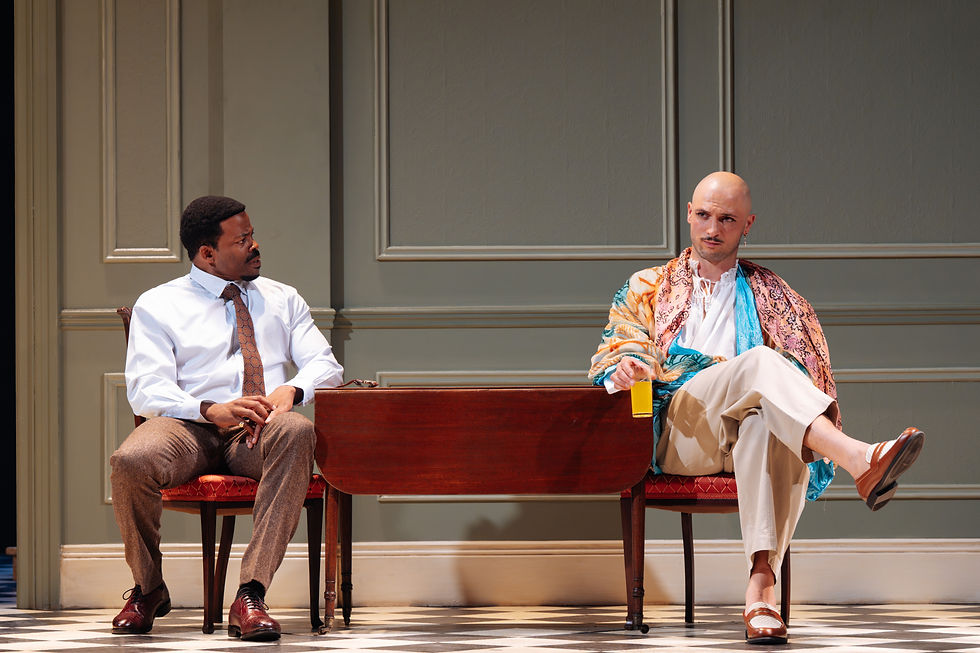
First performed in 1895, An Ideal Husband is an ensemble production following a community of friends, family and lovers within the political world. Without giving too much away, there is a husband, Sir Robert Chiltern (who is also a member of the House of Commons) that is blackmailed for a decades-long secret that he has not revealed to his wife and is trying to keep that way. During the two and a half hour performance, we see him try to do whatever he can to suppress the confession of his former sins - because he doesn’t want anything to ruin the image that his wife has of him. It brings up the questions of how far would you go to protect your image? In a union, should everything be revealed? Are some secrets worth keeping?
An Ideal Husband has since been revived in multiple iterations, both on screen and on stage. What made this different to the previous iterations, such as the 1999 film, was the very obvious fact that all the characters were written to be black instead. I like the way that this turned the story on its head, as nobody seemed out of place, despite the fact that if we were in the 1800’s they [characters] wouldn’t be in the positions of wealth and power that they were in.
What I appreciate the most about contemporary adaptations of classic art, is the way that two worlds collide. You can never entirely remove yourself from the essence of the piece, but it is an opportunity to approach the production as if you were writing a similar script in 2026. As you can imagine, a lot has changed since 1895, from the aesthetics, to language and also societal positioning of citizens. To directly reiterate such a successful piece of work would be a little lazy as well as boring to the modern day audience. When drawing comparisons, it’s evident that Barrie was very intentional to preserve the authenticity of the story that Wilde conceptualised all those years ago. The story itself barely changed, just the way it was told.
The set of the play was clearly a satirical take on traditional Greek Revival and Neoclassical style, that wouldn’t quite be what we found in our MPs houses today. There were multiple embedments of contemporary black music, internet references and language that blurred the timelines of when this could actually have been set, and at no point was that clarified, which I think made for a better watch. The costume was visibly dated, with big gowns and petticoats. Most of the dialogue was spoken in late modern english, similar enough to our english of today (no ‘thou’ or ‘thee’) but still articulated in a very formal manner. Formality was also informed by the fact that the characters were all of wealth too. This made the story easier to follow than if I were watching, say, traditional Shakespeare.
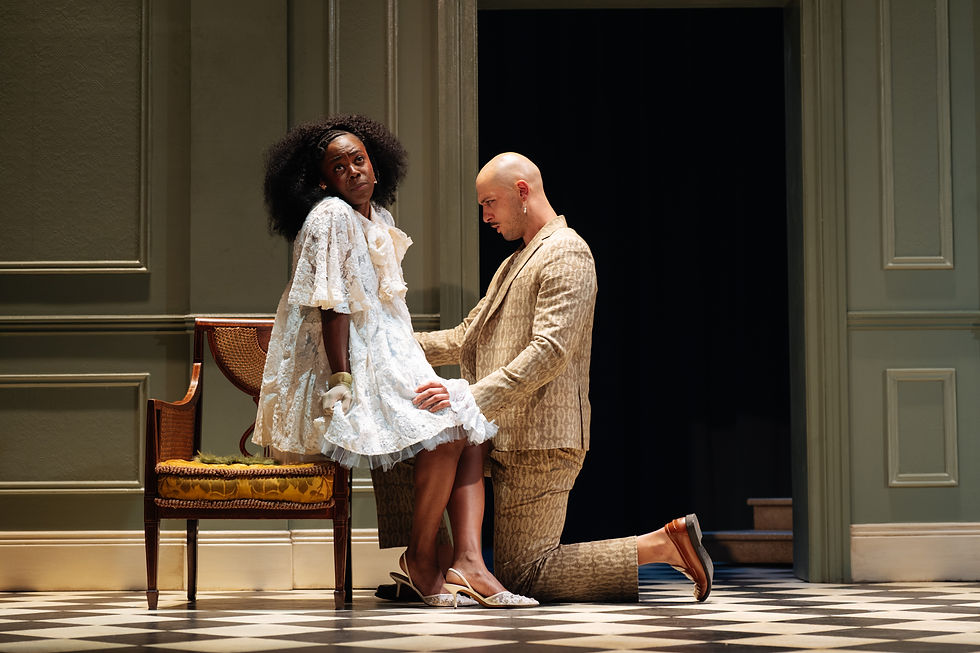
We were put into many different scenes, and the set reflected that. They adapted the stage during the show in a way that was creative. Having the outfit and set changes happen with the lights on in some way breaks the fourth wall, reminding us that this is a performance but also acts as a mini-interval. It’s very fascinating for those who are more curious about the elements that come together to produce a set, as we see the backdrop of the wall disappear into the ceiling, the actors pick up and put down chairs and tables, and reinvent the space entirely within less than a minute.
A brilliant touch was the fact that the elders were Caribbean. The accents were used set apart the new generation to the older one, like how it is in a lot of black homes today. It doesn’t matter how long your (grand)parents have been settled in the UK, they refuse to adopt a British accent.
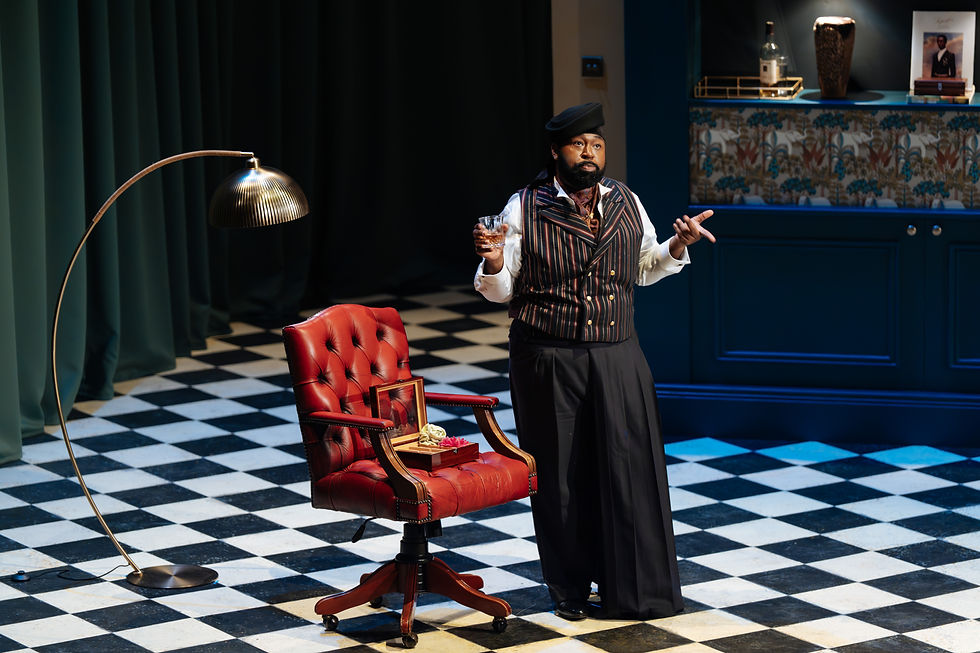
I was excited to see that there was a full ensemble cast for this play. That being said, during the opening scene of the full cast dancing and jubilating at the Chiltern’s house for a gathering, I was immediately worried that there were too many people on stage.
But, my worries were soon diminished. Every character on stage had an important role to play even the butler Mason/Phipps who felt like a caricature of Jeffrey from Fresh Prince of Bel Air and provided a lot of the audience’s laughs through his adlibs and disdain for his employers. The role was played by Emmanuel Akwafo, actor, writer and producer, who's credits including Limp Wrist & The Iron Fist as well as Ryan Calais Cameron’s For Black Boys. Retaining the density of the cast was another way that Barrie didn’t steer too far away from the original text. Wilde knows how to put the pieces of a puzzle together very well, and Barrie directs in a way that allows for character development within each individual without feeling overwhelming.
Across the cast there were very strong performances from both the actors that were familiar to me and the ones that I was just encountering for the first time. A new name to me was Jamael Westman, who alongside his on-stage situationship, Mabel Chiltern, Tiwa Lade were providing me with the most belly laughs.
Westman nailed comedic timing and the way that his character, Lord Goring was built blurred lines of identity and gender expression, which weren’t delved into deeply but hinted at multiple times across the show. There may have been room to question where his orientation lay, and though he never clarified, he ended up with a woman anyway. Even so, who actually cares? A genderfluid queer mixed-race Lord actually sounds like someone I’d like to invite to my gatherings, too. I also have to make a notable mention of the fact that Lord Goring brought out his vape whilst he was going through a seemingly stressful situation. I found that hilarious; another way of blending the two timeframes.
I loved the way that the show played on archetypes reflected in real life. Within the all-Black cast, the ‘villain’ was the fairer skinned person, played by Aurora Perrineau. This goes against everything we understand regarding colourism in the black community and the way it’s reflected in mainstream media today where the fairer you are, the more innocent you are perceived to be, and on the opposite end the antagonist often ends up being someone who is darker skinned. If this was deliberate, then this was a very refreshing take to see play out on stage, and a very brave choice to make, too.
Another interesting perspective was to see the sister-in-law of Sir Robert, Mabel Chiltern be dominant and demanding in the way she wants to be loved and courted. She made a mention of having one man (off screen) that proposes weekly on Tuesday and Thursday despite her consistent rejection, as well as having very high standards of Lord Goring (essentially her “shooting her shot”) whilst he was pining after her. As a dark skinned woman, who grew up not being desired by many and internalising that to the detriment of my personal confidence, I loved seeing Mabel on stage not struggle or have to beg for suitors. She simply existed and they flocked to her, as it should be.
Overall, the play was a great watch. The run time may be a bit daunting, but time flew with all the secrets that continued to reveal themselves. The show was perfectly paced and I loved the cast's dance intervals between scenes; playing songs that travel through multiple eras of Black British music that also appear on my personal playlists such as Why Don’t You by Cleo Sol, Dy-Na-Mi-Tee by Ms Dynamite and God Gave Me Feet For Dancing by Ezra Collective and Yazmin Lacey.


Encontré bastante interesante este contenido porque explica el tema de manera accesible. Para quienes tienen interés en la loteria nacional, encontrar una referencia clara puede facilitar mucho las consultas habituales. Además, disponer de información organizada permite revisar diferentes datos con mayor tranquilidad y evita depender de información poco clara.
A Chunky Wool Scarf can pair nicely with coats, sweaters, jackets, and casual winter clothing. Its textured appearance adds a cozy touch without making styling difficult. Wool also holds warmth well, making it suitable for long walks or daily travel.
Anyone found the MPPIA membership roster useful for networking in BC's film industry? I'm a freelance production coordinator trying to break into the Vancouver film scene. I keep hearing about the MPPIA but I'm not sure if their membership list is actually helpful for networking. Is it just a list of names or does it actually connect you with people who can hire you?
For anyone searching for a fun browser challenge, Drive Mad combines precise controls with clever level mechanics that reward patience.
Avec le temps, je me suis rendu compte que l’expérience sur une plateforme de jeux dépend beaucoup de petits détails que l’on ne remarque pas immédiatement. La rapidité des transitions, la disposition des sections et la cohérence visuelle influencent fortement le confort d’utilisation. Certaines interfaces donnent une bonne impression au premier regard, mais deviennent moins pratiques après plusieurs minutes. Dans cette logique d’observation, j’ai regardé Magical Spin Casino afin de comparer la façon dont différents espaces en ligne organisent leurs contenus et accompagnent l’utilisateur dans sa navigation.