
.png)
"The Streets Still Sing His Name" Spotify Presents Asake: One Night Only


Asake is a shapeshifter, and a smart one at that. When you carve out a lane big enough that makes space for you to grow within it, it allows you to change your stripes for spots and for your sound to be malleable. However, to wield this kind of versatility well, a strong foundation rooted in identity is required. From Mr. Money With The Vibe all the way to his joint project with Wizkid, Real Vol. 1, his distinct vocals accompanied by chorus and choir and laced with Fuji influences make him recognisable; regardless of whether he's being featured or the star of the track.
Having such an unshakable sonic base allows him to explore his inspirations in music without changing direction. When he started to explore Piano and Afrohouse on Work of Art, it opened his fanbase up to fusion and bending of quite a rigid genre that has been modernised in the process. That experimentation deepened into Lungu Boy, adding other sounds to the repertoire that gave him an international edge through collaborations with artists such as Stormzy and Travis Scott. Now, his study takes another step with M$NEY, but it is well within his stride: taking R&B into the fold, with Soul and Amapiano as the driving force.
Initial reactions to M$NEY suggested that Asake's latest offering had not landed with quite the same universal embrace as his previous releases. Some critics questioned the shift, while others wondered whether the album possessed the immediacy of Mr. Money With The Vibe or the cultural dominance of Work of Art. Yet, inside London's historic Royal Theatre Drury Lane for Spotify's One Night Only event, those conversations felt distant.

The atmosphere inside the black tie affair was electric. Gathered in the heart of Central London were fellow musicians, tastemakers, media personalities and, perhaps most importantly, some of Asake's most dedicated supporters, many of whom earned their place through Spotify. If there were doubts about the album's reception, they evaporated almost instantly. The audience breathed life into the project. Every lyric was returned with conviction, every melody echoed back towards the stage. It served as a reminder that while critical consensus has its place, Asake remains, above all else, a man of the people. He still holds, and will always hold, the ear of the streets.
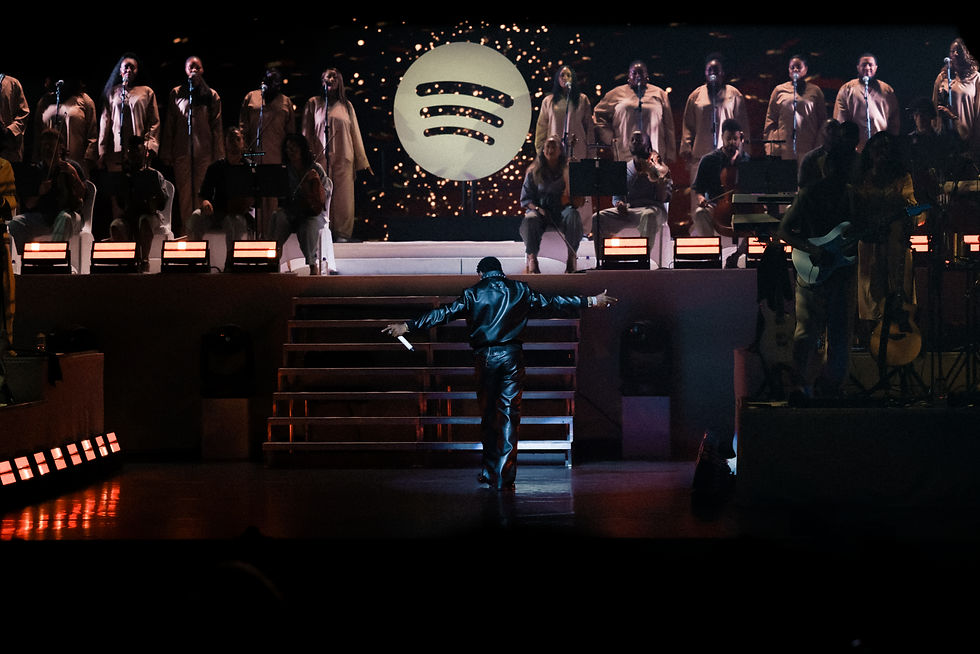
Opening with an undisclosed track that may well hint at future material or a deluxe edition, Asake immediately established that M$NEY is intended to be experienced as much as heard. Dressed in a two piece leather ensemble complete with a diamond encrusted collar, he commanded the stage with an ease that only comes from genuine star power. There was very little exertion required. Asake has long carried himself with the confidence of someone convinced of his own greatness, and now, having watched his ascent in real time, it is difficult to argue otherwise.
The staging reflected that confidence. Clean and minimal, the production placed Asake firmly at the centre, framed by his live band and choir with sparse visuals and the Spotify insignia behind him. A singular spotlight often followed him, emphasising the evening's real focal point: the music and its maker.

One of the night's most striking moments came during Gratitude. Performed almost as a ballad, with Asake positioned behind a solitary microphone stand as the choir emerged either side of him, the record took on an entirely different life in a live setting. Audience members rose instinctively to their feet, transforming the theatre into something closer to a place of worship than a concert venue. It reinforced just how integral live instrumentation has become to Asake's artistry. Throughout the night, strings, percussion, keys, brass and choir were essential storytellers to enthusiastic listeners.
Elsewhere, Amen demonstrated the power of collective experience, with call-and-response exchanges reverberating across the auditorium, while MCBH triggered the night's most explosive reaction. Despite instructions for attendees to remain seated for filming purposes, the infectious spirit proved impossible to resist. People rose anyway. Bodies moved. Voices stretched beyond decorum. In that moment, the theatre belonged to Asake and his audience.

Why Love provided another standout, largely thanks to the band's commanding brass section, whose trumpets briefly stole the spotlight and highlighted the richness of Asake's increasingly expansive sonic palette. Meanwhile, Badman Gangsta offered a poignant example of fan devotion, as the crowd effortlessly filled in Tiakola's absent verses without missing a beat.
There were quieter moments too. At one point, Asake sat on the steps of the stage, seemingly taking stock of the occasion while continuing to perform. It felt like an artist acknowledging the scale of his own journey: from YBNL's newest signee to one of African music's defining stars.
Closing with Asambe and Skilful, mirroring the sequencing of M$NEY itself, Asake brought the evening full circle. Spotify's One Night Only series is designed to create intimacy between artists and fans, but this particular performance revealed something more profound.
Whatever reservations some listeners may still hold about M$NEY, the connection between Asake and his audience remains unshaken. And perhaps that, more than any review score or online discourse, is the true measure of an artist's success.


Sau khi thấy một số người chia sẻ, mình cũng vào Debet xem qua để tham khảo cách họ làm giao diện và chia chuyên mục. Cảm nhận ban đầu là trang web trình bày rất mạch lạc, bố cục cân đối và chia khu vực rõ ràng nên nhìn rất thoáng mắt. Mình cũng để ý việc di chuyển giữa các mục khá thuận tiện nhờ thanh điều hướng được bố trí rõ ràng. được thiết lập với các chuyên mục riêng biệt, tạo cảm giác dễ tìm kiếm thông tin nên người mới cũng không mất nhiều thời gian để làm quen.
Trong lúc xem một số bài thảo luận, mình bắt gặp có người dẫn lại thông tin từ website Zbet này nên mở vào đọc thử. Mình xem một bài khá kỹ rồi lướt thêm vài nội dung liên quan để hiểu rõ hơn về chủ đề. Sau khi lướt qua một lượt, mình thấy bố cục khá đơn giản, Vì chỉ mới xem sơ qua nên đây chủ yếu là cảm nhận ban đầu về bố cục và cách trình bày. Sau khi xem một vòng mình thấy giao diện trực quan và dễ theo dõi.
Lần đầu ghé EA88 mình chủ yếu xem bố cục và cách các phần nội dung được phân chia trên trang. Cảm nhận ban đầu là trang web trình bày rất mạch lạc, bố cục cân đối và chia khu vực rõ ràng nên nhìn rất thoáng mắt. Mình cũng để ý việc di chuyển giữa các mục khá thuận tiện nhờ thanh điều hướng được bố trí rõ ràng. Vì chỉ mới xem sơ qua nên đây chủ yếu là cảm nhận ban đầu về bố cục và cách trình bày.
Sau khi thấy một số người chia sẻ, mình cũng vào LV88 xem qua để tham khảo cách họ làm giao diện và chia chuyên mục. Mình xem một bài khá kỹ rồi lướt thêm vài nội dung liên quan để hiểu rõ hơn về chủ đề. Sau khi lướt qua một lượt, mình thấy bố cục khá đơn giản, được thiết lập với các chuyên mục riêng biệt, tạo cảm giác dễ tìm kiếm thông tin nên người mới cũng không mất nhiều thời gian để làm quen.
Trong lúc xem một số bài thảo luận, mình bắt gặp có người dẫn lại thông tin từ website 88VBET này nên mở vào đọc thử. Tổng thể khá thoáng khi từng khu vực có khoảng cách riêng và không tạo cảm giác quá nhiều thông tin chen vào nhau. Menu cũng được tổ chức rõ và việc chuyển đổi giữa các khu vực khá nhanh. Sau khi xem một vòng mình thấy giao diện trực quan và dễ theo dõi. Vì chỉ mới xem sơ qua nên đây chủ yếu là cảm nhận ban đầu về bố cục và cách trình bày.